
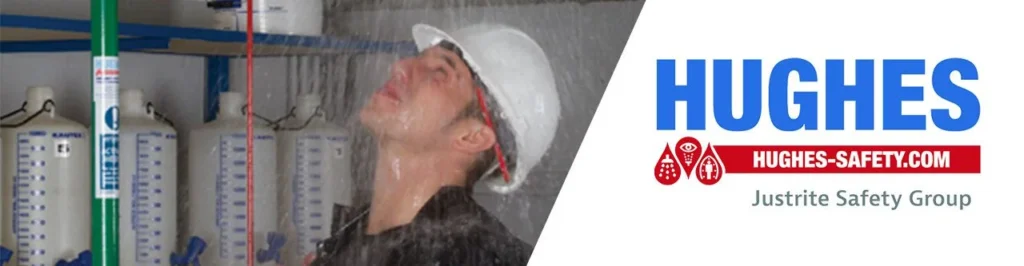
Emergency Showers and Industrial Eye Washes
Emergency showers and eyewash stations are necessary and mandatory solutions for all work environments where personnel may come into contact with dangerous substances or are subjected to high temperatures.
Hughes is the Justrite brand specializing in the production of emergency showers, eye/face washes and decontamination equipment for over 50 years.
Emergency showers and eye and face wash units are the first aid response in case of contamination with hazardous chemicals, dust, metal shavings. It is essential to act immediately to prevent serious injuries, possible long-term consequences, permanent disability and, in some cases, death.
Justrite Italia offers the complete lines of Hughes emergency showers and eyewashes, necessary for the management of all chemical contamination cases for each industrial sector, in both fixed and mobile versions and for internal and external environments.
These collective safety devices for personnel must be installed and present by law in all environments that present the risk of contamination or exposure to acids, gases, toxic vapors and in places with excessively high temperatures. The European standard EN15154 and the internationally recognized ANSI Z358.1-2014 standard establish the requirements for industrial eyewash stations and emergency showers.
These standards are specific to the performance, use, installation, testing, maintenance and training of this safety-critical equipment. Discover the complete offering and avoid serious accidents and injuries, contact Justrite Italy experts for a free consultation and quote.
Emergency Showers and First Aid Eye Washes for Any Need
Request a free quote for all Hughes decontamination solutions, Justrite Italia experts will guide you in choosing the solution that best suits your needs and will perform the risk analysis at your company free of charge.
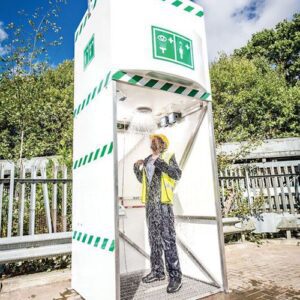
EMERGENCY SHOWERS FOR OUTDOOR ENVIRONMENTS
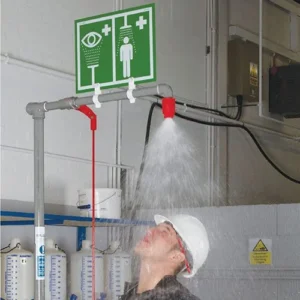
EMERGENCY SHOWERS FOR INDOOR ENVIRONMENTS
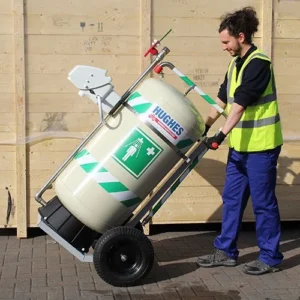
PORTABLE EMERGENCY SHOWERS
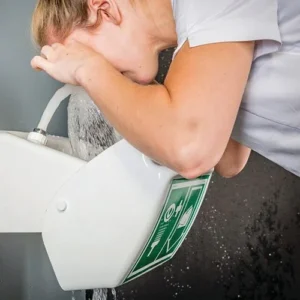
EMERGENCY EYE WASH
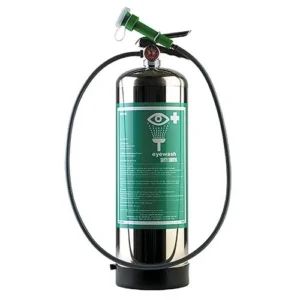
PORTABLE EMERGENCY EYE WASHER
Regulations Applicable to Emergency Showers
The EN 15154 standard consists of 4 parts:
- Part 1: Regulates emergency showers with water connection
- Part 2: Regulates eyewash stations with water connections
- Part 3: Regulates portable emergency showers
- Part 4: Regulates portable eyewash stations
This regulation was created to regulate the presence and supply of liquid, in an adequate and sufficient quantity to allow washing of the body and/or eyes, in all those work environments that present risks of contamination, contact with dangerous substances or in the event of fire.
The EN 15154-1 standard establishes for emergency showers:
- Height: the height of the showers must be such as to allow 50% of the water jet to cover a radius of 200 mm from the centre of the shower and 95% of the jet to reach a radius of 400 mm from the centre of the shower.
- Water delivery duration and flow rate: the capacity in litres of drinking water supplied by emergency showers, equipped with a water connection, must comply with the quantity L/min required by local laws and, if no law is applicable because it is not issued locally, then it will have to be 60 liters/minute and be provided for At least 15 consecutive minutes.
How to Choose an Emergency Shower and/or Eye Wash?
Before choosing the emergency station for washing and decontamination of personnel, it is necessary to carry out the analysis and assessment of risks in the workplace.
This analysis allows us to determine both how many showers and/or eyewash stations are needed and the right place to install these emergency stations.
In general, it is therefore recommended to follow these steps:
- Perform a careful and accurate risk analysis
- Carefully read the safety data sheets of hazardous chemicals used by personnel
- Calculate the number of people who are potentially exposed to risk factors and who may therefore have to use these emergency systems (high temperatures, use of dangerous substances, etc.)
Where to Install the Emergency Shower?
The emergency shower, as well as the first aid eyewash, must always:
- Be positioned as close as possible to the work area that presents risks of contamination or high heat
- Ensure free access and be easily reachable
- Be well lit even in the event of power cutsThe shower itself must also be clearly visible and immediately identifiable with panels or signs on all sides.
What Should I Consider When Installing the Shower and/or Eye Wash Station?
- Room temperature
- Presence or absence of factors that could contaminate the drinking water from the shower or eyewash
- Presence or absence of water connection
- Presence or absence of fire and explosion risk factors
- Presence or absence of ATEX electrical systems for fire/explosion risk areas
- Whether or not it is necessary to deactivate the shower and/or eyewash station for maintenance operations or other production needs
- Possibility of risks or damages when using emergency washing stations in case of water spill
Frequently Asked Questions about Emergency Showers and Eye Washes
When are emergency showers and eyewash stations mandatory in the workplace?
They are mandatory in all work environments where personnel may come into contact with hazardous chemicals, dust, metal shavings, or be exposed to high temperatures. The need for them must be determined through a risk assessment based on the safety data sheets for the substances used.
What regulations govern emergency showers and eyewash stations?
The European standard EN 15154, divided into four parts (showers with water connection, eyewashes with water connection, portable showers, portable eyewashes), and the international standard ANSI Z358.1, which establish their performance, installation, testing and maintenance.
How much water should a standard emergency shower provide?
In the absence of specific local legislation, the EN 15154-1 standard requires a flow rate of 60 litres per minute, delivered for at least 15 consecutive minutes, with a jet coverage reaching a radius of 400 mm from the centre of the shower for 95% of the water delivered.
Where should an emergency shower or eyewash station be placed?
As close as possible to the risky work area, with free and immediate access, well-lit even in the event of a power outage, and marked with panels or signs visible from all sides.
Are there emergency showers for spaces without a water connection?
Yes, the EN 15154 standard also specifically provides for portable showers and eyewash stations (parts 3 and 4), ideal for outdoor environments, construction sites or areas without a water connection.
Have a question or want to learn more? Fill out the form and tell us about your needs.
We will contact you shortly to provide the necessary technical advice and the best quote, free of charge and with no obligation.